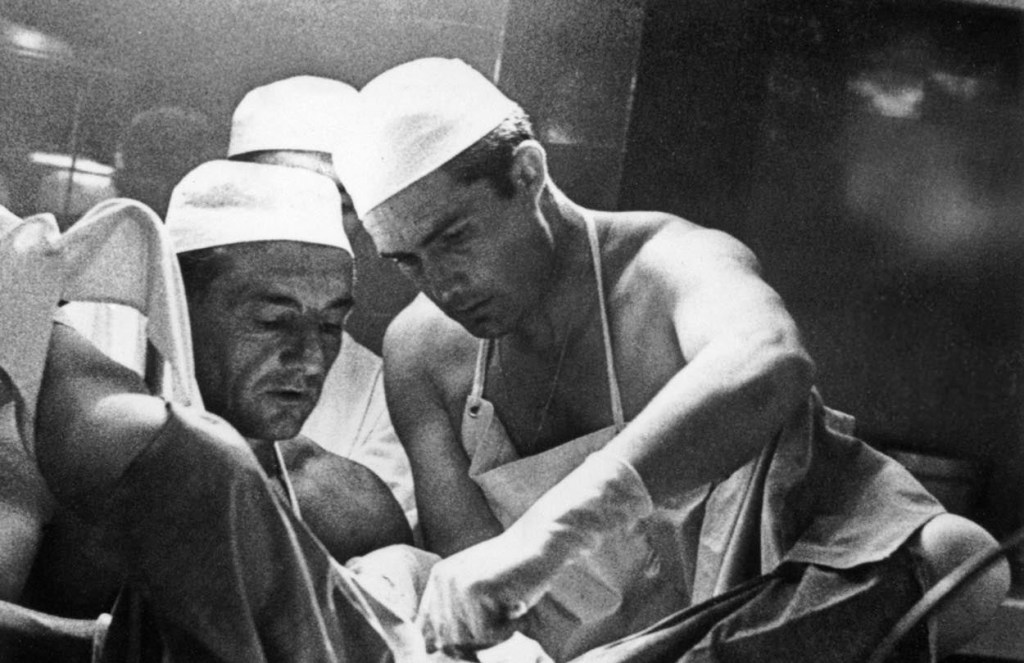
Did you know that between 1966 and 1979, Johns Hopkins Hospital operated a full-suite gender affirming care clinic and performed thousands of gender-affirming surgeries? This is that story.
In 1965, the head of plastic surgery at Johns Hopkins Hospital, Dr. Milton Edgerton, joined with psychologist John Money and endocrinologist Claude Migeon in founding the Johns Hopkins Gender Identity Clinic.
This was the first time an American hospital was associated with surgical gender-affirming operations, so it was a major development. Keep in mind – this is 4 years before the Stonewall Uprising.
The founding of the Clinic was shrouded in secrecy, but went public in 1966, the year it began taking patients. The Johns Hopkins Gender Identity Clinic publicized itself with the slogan: “Then, perhaps we should consider changing the body to fit the mind.”
Dr. Edgerton was intrigued and inspired by the much-publicized case of Christine Jorgensen, an American actress who traveled to Denmark in 1951 to undergo a series of gender-affirming surgeries. Jorgensen is believed to be one of the first openly trans celebrities, essentially going on a press tour to talk about her experiences.
Edgerton pitched the Clinic to his colleagues as a way of making Johns Hopkins the foremost provider of gender-affirming care in the United States. With only a handful of private providers offering surgical options prior to the Clinic’s opening, many patients were traveling to clinics in Europe, Mexico, and Morocco – with mixed results.
For Edgerton, he was inspired to pursue gender-affirming surgery with the observation that, “Not a single patient, no matter how bad the surgery that had been performed, regretted his or her trip the operation. And that was pretty impressive.”
Through the Clinic, Edgerton and colleagues included well-known patients, including English author Dawn Simmons, who once claimed, “The surgery was so successful, I became pregnant!” By 1969, the Clinic reportedly had received approximately 1,500 prospective patients vying for just 24 surgery spots. Word was getting around.
Ultimately, the Clinic was open a little over 13 years, closing abruptly in 1979. According to the hospital, the decision was made due to a growing tide of professional and published backlash that claimed that gender-affirming surgeries were ineffective. That’s only half the story though –
While there were published studies that devalued gender-affirming surgery, there were also plenty of studies coming out that confirmed the positive impact of these procedures – with direct testimonies of patients and their providers.
There’s not currently any published data on just how many surgeries were performed at the John Hopkins Clinic, but estimates range between 4 and 10 thousand. Patients also had access to psychiatric treatment and hormones at the Clinic, creating an all-inclusive experience.
It’s important to mention that the John Hopkins Clinic wasn’t ALL good for the trans community. They enforced a very binary system of gender realignment for their patients, leaving no space for ambiguity or androgyny. The Clinic had a clear pattern of rejecting patients who they believed would not “pass” as their reassigned sex. They also rejected patients whose gender expression was non-binary. Ultimately, the John Hopkins Gender Identity Clinic was both revolutionary and very much a product of its time – it rejected the notion of queerness while accepting the idea that people should have agency to change their gender.
Sources:
Baker, Paula. “A Changing of Sex by Surgery Begun at Johns Hopkins.” New York Times, November 21, 1966. https://www.nytimes.com/1966/11/21/archives/a-changing-of-sex-by-surgery-begun-at-johns-hopkins-johns-hopkins.html.
Binkowski, Brooke. “To Protect Gender-Affirming Care, We Must Learn from Trans History.” Harvard T.H. Chan School of Public Health, March 15, 2023. https://hsph.harvard.edu/news/to-protect-gender-affirming-care-we-must-learn-from-trans-history/.
Borrelli, Christopher. “Benefits of Transsexual Surgery Disputed as Leading Hospital Halts the Practice.” New York Times, October 2, 1979. https://www.nytimes.com/1979/10/02/archives/benefits-of-transsexual-surgery-disputed-as-leading-hospital-halts.html.
Hopkins Medical Archives. “Gender Identity Clinic Press Conference, 1966.” SoundCloud audio, accessed May 28, 2026. https://soundcloud.com/hopkins-medical-archives/gender-identity-clinic-press-conference-1966.
Kozlowska, Katie. “Gender-Affirming Care Has a Long History in the US — and Not Just for Transgender People.” The Conversation, March 14, 2023. https://theconversation.com/gender-affirming-care-has-a-long-history-in-the-us-and-not-just-for-transgender-people-201752.
McFadden, Robert D. “Dawn Langley Simmons, Flamboyant Writer, Dies at 77.” New York Times, September 24, 2000. https://www.nytimes.com/2000/09/24/nyregion/dawn-langley-simmons-flamboyant-writer-dies-at-77.html.
Roberts, Sam. “Milton Edgerton, Trailblazing Plastic Surgeon for Children and Transgender Patients, Dies at 96.” Washington Post, July 16, 2018. https://www.washingtonpost.com/local/obituaries/milton-edgerton-trailblazing-plastic-surgeon-for-children-and-transgender-patients-dies-at-96/2018/07/16/28bcae0a-8836-11e8-8aea-86e88ae760d8_story.html.
Stanley, Eric. “Gender-Affirming Surgery at Johns Hopkins.” STAT, October 3, 2022. https://www.statnews.com/2022/10/03/gender-affirming-surgery-hospitals-johns-hopkins/.
Turban, Jack L., Alex S. Keuroghlian, and colleagues. “A History of Gender-Affirming Care.” New England Journal of Medicine 387, no. 14 (2022): 1279–81. https://pubmed.ncbi.nlm.nih.gov/36191317/.
YouTube. “Johns Hopkins Gender Identity Clinic.” YouTube video, accessed May 28, 2026. https://www.youtube.com/watch?v=ciikERkmvFA.


Leave a Reply