Did you know that when the Nazis began burning books in Berlin in 1933, the first books they targeted were those on gender affirming care?
Welcome to Queer Legacy, where you can join me, Svetlana Harlan, PhD, on a quest to uncover queer history. This is the history of Gender Affirming Care, Part 1.
Evidence of gender-affirming care (GAC) dates back to prehistoric times. Ancient records acknowledge gender variance and early attempts at medical and surgical treatments. There is evidence of transgender people and gender affirming care as early as the year 1200 BCE in parts of Africa and North America.
However, it’s important to keep in mind that our societal understanding of “modern medicine” and all that it encompasses is relatively recent, dating back to around the mid to late 19th century. So, I’ll be exploring the history of gender affirming care within the context of modern medicine.
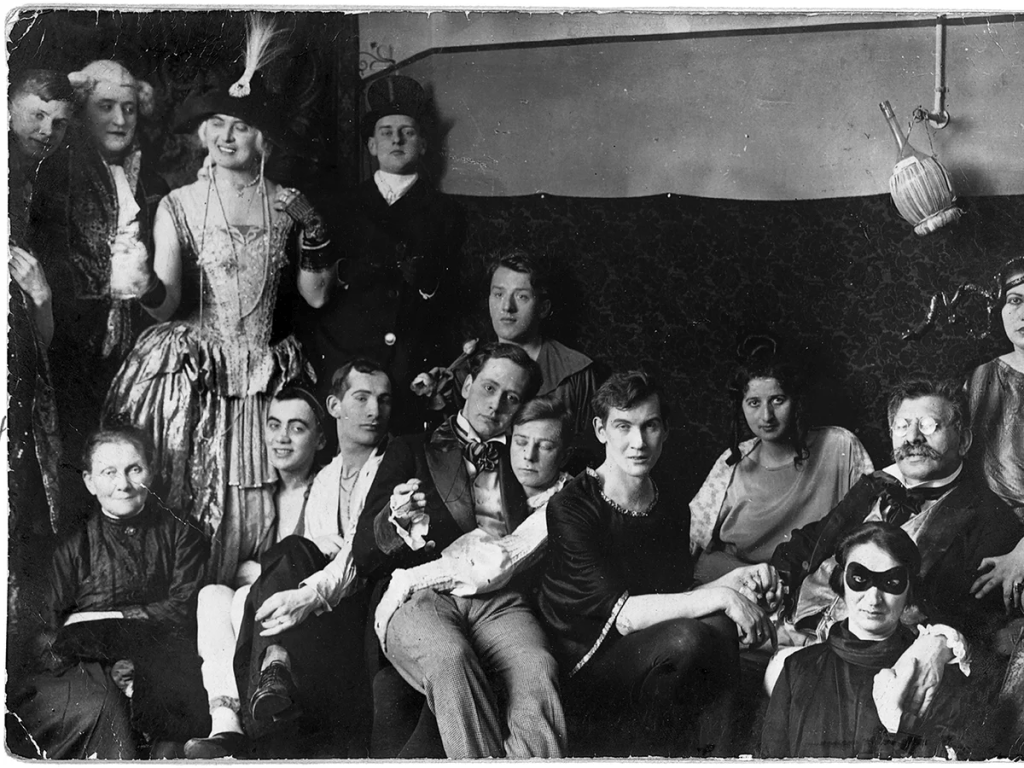
The first modern gender-affirming surgical procedures date back to the early 20th century in Germany. It was Magnus Hirschfeld, German physician and sexologist, who pioneered these procedures. Hirschfeld’s advocacy work for “sexual minorities,” as queer folks were politely referred to back in the day, dates back to the late 1800s. He founded the Institute of Sexual Science in 1919, a research and clinical facility – the first of its kind.
The first gender-affirming care performed by the Institute wasn’t actually hormonal or surgical – it began with collecting extensive data on transgender people’s lived experience through interviews, surveys, and clinical observations. This data collection allowed clinicians to build a picture of the transgender experience and became the foundation for gender-affirming care.
At the Institute, Hirschfeld and colleagues prescribed some of the earliest hormone replacement medications newly available in the 1920s, including androgens, estrogens, and progesterons.
In two separate procedures in 1922 and 1931, Hirschfield and colleagues performed one of the earliest documented vaginoplasties on Dora Richter, one of the Institute’s employees. The institute’s most famous patient was arguably Danish painter Lili Elbe, whose life story was popularized by the film The Danish Girl.
In 1933, after the Nazi regime had gained power, Hirschfeld’s institute was shuttered. Most people know that the Nazis started their reign of terror with book burnings. What many don’t know is that the books and research of the Institute of Sexual Science were burned first.
Hirschfeld himself, who also happened to be Jewish, was able to flee Germany, dying just two years later in France at the age of 67.
Make sure to hit the like button, share this video, and follow Queer Legacy to see Part 2 of the History of Gender Affirming Care
Sources & Recommended Reading
“A History of Gender Affirming Care.” GenderGP. Accessed May 28, 2026. https://www.gendergp.com/a-history-of-gender-affirming-care/.
Binkowski, Brooke. “To Protect Gender-Affirming Care, We Must Learn from Trans History.” Harvard T.H. Chan School of Public Health, March 15, 2023. https://hsph.harvard.edu/news/to-protect-gender-affirming-care-we-must-learn-from-trans-history/.
Meyerowitz, Joanne J. “Transgender History, Part II: A Brief History of Medical and Surgical Gender-Affirming Care.” American Journal of Public Health 112, no. 11 (2022): 1561–68.
Rose, Ralf. Magnus Hirschfeld: The Origins of the Gay Liberation Movement. New York: Monthly Review Press, 2014.
“The First Institute for Sexual Science (1919–1933).” Magnus-Hirschfeld-Gesellschaft. Accessed May 28, 2026. https://magnus-hirschfeld.de/ausstellungen/institut-fuer-sexualwissenschaft/.
Yale, Kaitlin. “A History of Transgender Health Care.” Scientific American, April 6, 2022. https://www.scientificamerican.com/article/a-history-of-transgender-health-care/.
 Queer Legacy
Leave a comment